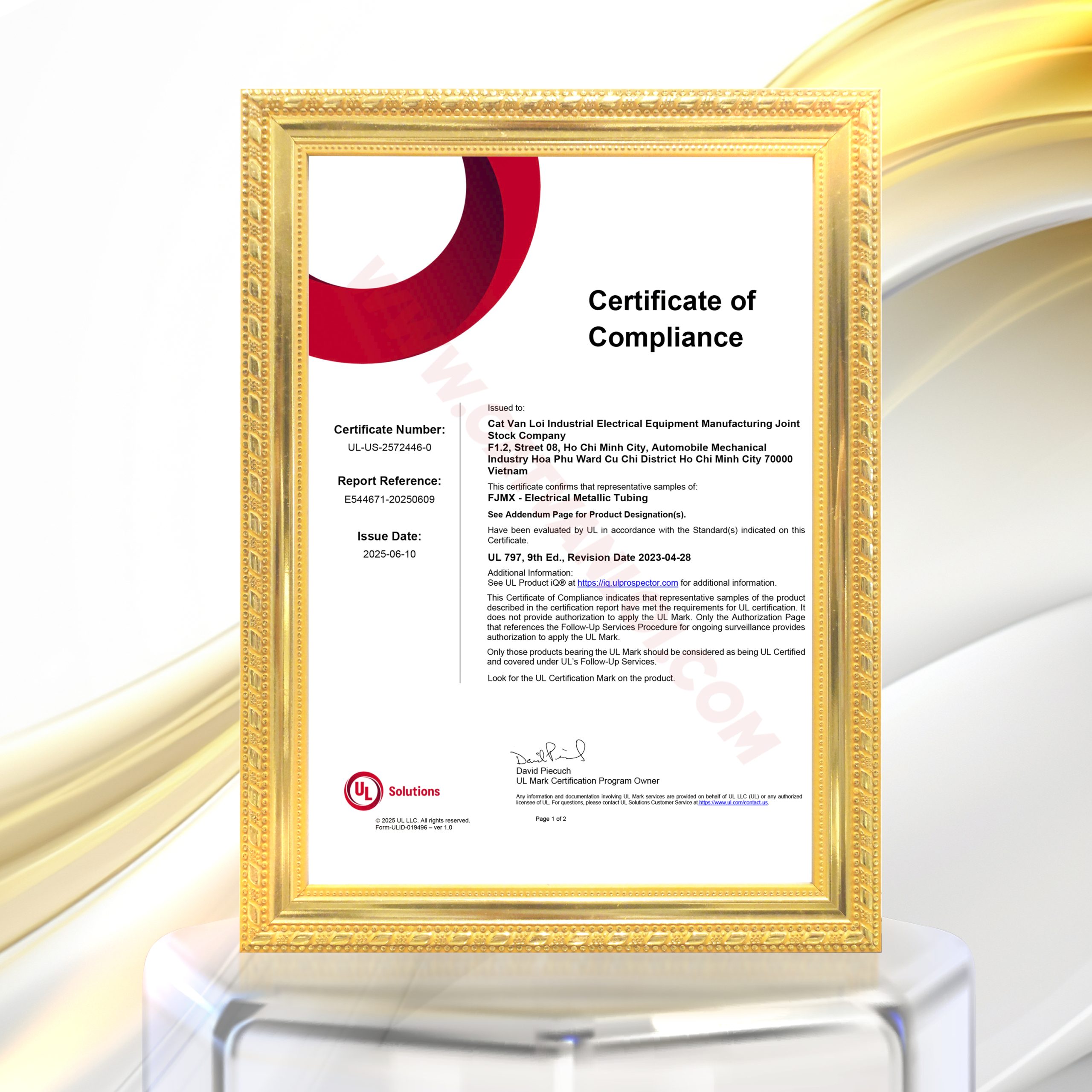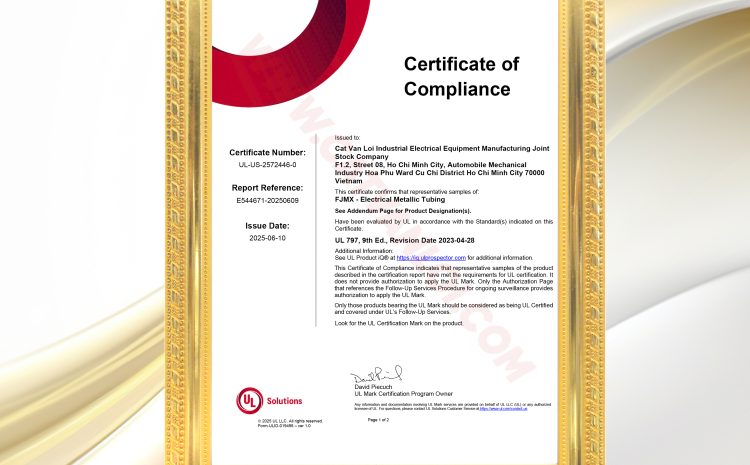
EMT STEEL CONDUIT UL 797 FOR KEY PROJECTS: WHY DO 100% OF INTERNATIONAL SUPERVISION CONSULTANTS ONLY ACCEPT UL LISTED CERTIFICATION?
I. EMT STEEL CONDUIT UL 797 – THE SHIELD PROTECTING ELECTRICAL SYSTEMS
EMT Steel Conduit UL 797 (Electrical Metallic Tubing) is the most widely used component in MEP (Mechanical, Electrical, and Plumbing) systems across commercial buildings, industrial zones, and high-end civil construction projects in Vietnam, such as airports, metro stations, and data centers. Serving as a shield for electrical systems and a fire barrier, EMT conduit demands stringent requirements regarding structural ductility and heat resistance.
An alarming reality: many trading companies import EMT conduits from China, infiltrating projects through low-price strategies. They then take a few “best-quality” conduit samples to Quatest 1 or Quatest 3 to obtain test reports based on a few selected UL 797 criteria, using these documents to equate them with official UL Listed certification. This is a sophisticated substitution of concepts, where the ultimate victims are none other than the project owners and the end-users.
Let us compare the technical and legal aspects to understand why demanding supervision consultants always reject “sample-tested” goods and only approve EMT conduits bearing the UL Listed mark.
II. COMPREHENSIVE TECHNICAL AND LEGAL ANALYSIS TABLE
ANALYSIS CRITERIA |
CAT VAN LOI EMT (UL Listed – UL 797 by UL LLC, USA) |
COMMERCIAL / NON-CERTIFIED GOODS (Sample Testing Only / “Fake” Certification) |
| Legal Status | Product Certification: Exclusive File Number, manufacturer name publicly displayed on the global UL Product iQ® directory – verifiable at any time. https://productiq.ulprospector.com/en/search | Test Report (Local laboratory results): Confirms only the single sample brought to Quatest 1, Quatest 3 at a specific time. Holds no legal value for the entire shipment at the project site. |
| Quality Assessment Process | Comprehensive & Strict: Inspections of steel raw materials, production lines, internal QA/QC systems, and actual product testing according to US electrical safety standards. | Extremely Lax: Isocert, TQC, Vinacontrol often only evaluate paperwork or a few basic criteria according to UL 797 standards. Lacks technical depth regarding actual electrical safety. |
| Factory Audit Mechanism | Mandatory Quarterly (4 times/year): UL experts conduct unannounced inspections at the Cat Van Loi factory, taking random samples directly from the production line. If standards are not met, the UL mark is immediately revoked. | None at all. After returning the sample test results, no one returns to inspect. Enterprises are free to change sources, reduce wall thickness, and thin the coating to maximize profit. |
| Conduit Wall Thickness & Uniformity | Absolute wall thickness uniformity according to UL 797 standards. No localized weak points – consistent electrical cable protection along the entire conduit route. | Non-uniform wall thickness (uneven thick and thin spots) due to lack of raw material control. Thin spots are prone to denting and crushing during installation, reducing cable protection. |
| Zinc Coating Quality | Zinc coating thickness meets UL micrometer standards. Durable rust resistance in humid, mildly acidic, and industrial chemical environments – lifespan of 15–20 years. | Thin coating, impure zinc. Conduit yellows, blisters, and rusts after only a few months of installation, especially in factory, coastal, or industrial park environments. |
| Bending Ductility | Ductile conduit, no cracking, denting, or breaking when using professional Conduit Benders according to the minimum bending radius of UL 797 standards. | Brittle, prone to denting or cracking when bent. At bending points, the conduit wall thins locally, creating mechanical weak points and reducing cable protection capability. |
| Project Acceptance Level | Absolute: Accepted by all international project owners, stringent supervision consultants (USA, Japan, Europe), and key national projects without negotiation. | Very Low: Often rejected by experienced supervision consultants during material submission review. Only passes in projects with weak quality control capabilities. |
| Legal Liability in Case of Incident | Manufacturer assumes full responsibility. Certification from UL LLC acts as an irrefutable legal shield for project owners, consultants, and MEP contractors. | Quatest, Isocert always disclaim liability: “Results are only valid for the sample provided by the customer.” Contractors and Owners bear full criminal and civil liability if an incident occurs. |
III. THE DISTINCTION BETWEEN “PRODUCT CERTIFICATION” AND “SAMPLE TEST REPORT”
Many project owners and MEP contractors in Vietnam remain confused, or are intentionally misled, regarding these two entirely different legal concepts:
- Product Certification – UL Listed: This is a comprehensive evaluation process covering raw materials, production lines, quality control systems, and final products. It is maintained through unannounced factory audits conducted four times per year. The result is a proprietary File Number that is publicly listed globally and verifiable by anyone at any time.
- Test Report (Sample Testing) – Quatest / Isocert / TQC: This is merely the result of testing a single sample brought to a laboratory at a specific point in time. There is no ongoing surveillance or audit mechanism. It does not represent any specific shipment and carries no legal weight in the event of a dispute.
The Cost and Risk Factor: While using “unofficial” conduit may lower initial procurement costs, the risks of electrical short circuits and the conduit corroding or disintegrating after only 1–2 years of operation will result in repair and replacement costs exponentially higher than the initial savings. This does not even account for the damage to a contractor’s reputation or the threat to human life.
An MEP system for a major project requires sustainable safety throughout its 20–30 year operational lifespan and cannot be gambled on a few isolated test reports for unverified, commercial-grade goods. Cat Van Loi’s UL certification dossier is provided as a complete, synchronized package covering the entire system, including conduits, fittings, and cable trays. This solution has been verified by the world’s strictest organization for technical compatibility, ensuring the system operates safely and durably while providing absolute protection for human life.
IV. CONCLUSION
The power of the “UL Listed” mark, backed by the official UL Listed – UL 797 certification from UL LLC (USA) on every Cat Van Loi EMT conduit, serves as an absolute guarantee of 100% consistent product quality. Furthermore, it is the only globally recognized legal assurance of uniform quality for every single meter of conduit that leaves the factory. This is an irreplaceable electrical safety solution for any project with rigorous quality standards—ranging from office buildings, commercial centers, and manufacturing plants to critical national infrastructure projects.